Water Resilience for Care and Essential-Service Estates
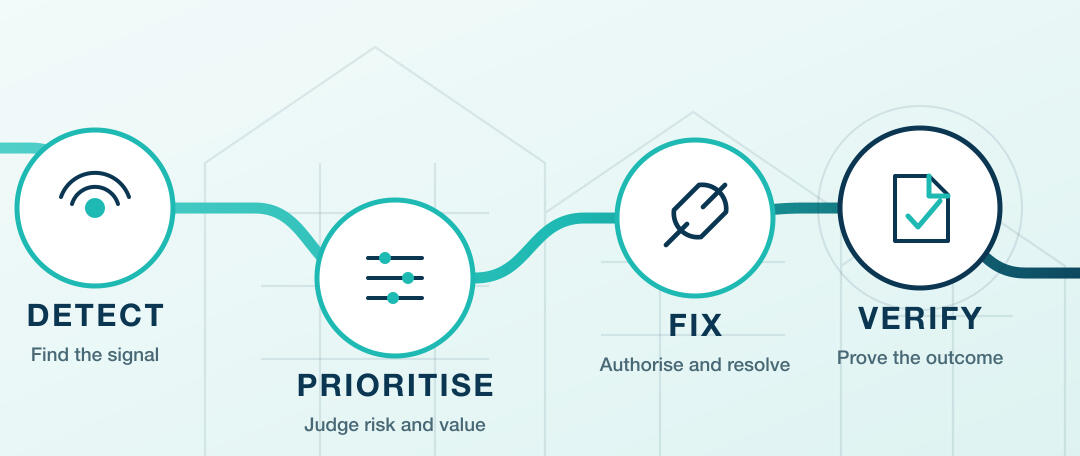
FROM WATER SIGNAL TO VERIFIED RESOLUTIONClear Future Water helps care and essential-service estates move from abnormal water use to safe, authorised repair and evidence that the problem has been resolved.One accountable control point across the complete pathway.Explore our care water resilience focusTHE GAP WE ADDRESSMany estates already have meter data, alerts, maintenance records and suppliers. Water can still be lost because responsibility is divided between systems and organisations. A signal may be received and a contractor may attend, but no one remains accountable for the speed, cost and water-saving outcome from beginning to end.Clear Future Water connects those stages through one operator-approved route, one case owner and one evidence record. We coordinate the people, data and decisions needed to move each accepted case from detection through prioritisation, authorised intervention and verified closure.ABOUT CLEAR FUTURE WATERClear Future Water Services Ltd was founded by Conor Griffin. Conor brings more than 25 years of experience in healthcare policy, regulated environments and multi-stakeholder programmes. His work has included governments, regulators, patient organisations, professional bodies, NGOs and international health institutions, as well as responsibility for multi-country programmes and budgets exceeding GBP 2 million.CFW leads the integrated pathway. Care operators retain authority over residents, sites, access and interventions. Technical, repair and evaluation partners remain responsible for their own professional, contractual and statutory duties.OUR PURPOSEMission Reduce avoidable water loss by turning data and identified risks into safe, prioritised and verifiable action.Vision A recognised water-resilience pathway for care and essential-service estates, with one point of managed accountability and care, safety and dignity protected throughout.Principles Safety first. Evidence. Integrity. Partnership. Accountability. Respect.How we work: assurance and governanceWATER LOSS IS A CARE CONTINUITY AND COST ISSUEIn a continuously occupied care environment, water may receive attention only when something goes wrong. Avoidable loss can remain a managed risk while other operational priorities take precedence. Yet every additional loss-day increases water and wastewater cost, may waste energy used to heat water, and can increase staff effort, callouts, damage risk and disruption.Water also supports hydration, hygiene, catering, laundry, infection control and personal care. The response must therefore reduce loss without compromising resident welfare, essential services or safe building operation.WHY NOWWater charges are rising and policy is placing greater emphasis on non-household demand reduction, resilience, better data and evidenced outcomes. This creates a stronger operational and commercial case for care estates to understand avoidable loss and improve the route from alert to completed action. It does not mean that care-home retrofit is currently mandatory.A REAL-WORLD CARE-ESTATE TESTClear Future Water has submitted a Water Efficiency Lab 2 application to test the integrated model across approximately ten occupied care homes over 18 months. The proposed pilot would use existing data and infrastructure first, adding monitoring only where it is likely to improve a decision, accelerate resolution or strengthen verification.The sensing layer will remain supplier-neutral and needs-led. A shared data and analytics environment will bring meter, sensor, maintenance and staff evidence into one case record. AI-enabled tools may assist anomaly review, localisation and priority where their capability is confirmed. People will continue to authorise access, dispatch work, close cases and approve savings claims.FROM ALERT TO VERIFIED RESOLUTIONDetect Combine existing meter data, needs-led sensing, maintenance records and frontline observations in one actionable case.Prioritise Assess water loss alongside consequences for residents, care delivery, the estate and the cost of delay.Fix Validate and pre-scope the case, align safe access and coordinate operator-authorised repair through an accountable workflow.Verify Close the case only when the action, cost and outcome are recorded and the evidence shows that abnormal consumption has stopped.A CONTROLLED LEARNING LOOPEach case will test the pathway in real conditions. Recorded outcomes will inform monitoring thresholds, triage, access arrangements, contractor guidance, repair-cost benchmarks and verification rules. Any material change will be reviewed and approved before use. The model is designed to learn without allowing uncontrolled automation.VALUE BEYOND THE WATER BILLThe evidence will cover water and wastewater savings, loss-days, response time, staff contacts, coordination effort, repeat visits, first-time fix, recurrence, repair cost and disruption. Hot-water energy, carbon, damage risk and resident impact will be reported only where the evidence supports them.STARTING FOCUSED, DESIGNED TO SCALECare homes are the deliberate starting point because the human and operational consequences of water disruption are especially clear. If the evidence supports wider adoption, the core model could be adapted for NHS and other essential public-service estates, with separate validation and governance for each setting.DISCUSS THE MODELWe welcome conversations with care operators, water companies, retailers, maintenance providers, insurers and evaluators interested in accountable water resilience and verified outcomes.Email [email protected]Clear Future Water Services Ltd | Company No. 17409941

CARE WATER RESILIENCESupporting safe, continuous care through better water preparedness, faster resolution and verified outcomesEXPLORE THE SERVICE PROTOCOL1. Detect | 2. Prioritise | 3. Fix | 4. VerifyCare homes depend on a safe, reliable water supply every hour of every day. Water is essential for hydration, personal care, infection control, cleaning, catering, laundry and the safe operation of buildings. 1 3A leak, supply interruption or water-quality incident can therefore become much more than a facilities problem. It can place vulnerable residents at risk, disrupt frontline care and create additional pressure for already stretched staff. 1 2THE RESILIENCE CHALLENGEVulnerable residents Older people and residents with complex health needs may be particularly susceptible to dehydration, heat-related illness and infection. Water incidents should be assessed according to their effect on people as well as their financial cost. 3 4Operational dependency Care services rely on water throughout their operations. A localised problem can affect bathrooms, kitchens, laundry, cleaning, heating systems and personal-care activities.Fragmented ownership Data, maintenance responsibility, access authority and suppliers may sit in different places. Delay can accumulate between the signal, investigation, approval, repair and proof of outcome.Preparedness and coordination Technology, storage and emergency supplies all have a role. Resilience also depends on trained people, clear authority, reliable communication and one coordinated route through the response. 1 2THE PROPOSED PILOTClear Future Water has submitted a WEL2 application to test one accountable pathway across approximately ten occupied care homes over 18 months. The model would connect existing water information, needs-led monitoring and frontline observations with care-sensitive priority, operator-approved access, authorised repair and verified closure.Each accepted case would have one owner and one evidence record. A named site manager or delegated contact would control access, safeguarding and timing. Staff could use an approved email, SMS, WhatsApp or location-linked QR route without adopting another technical application. Immediate risks would continue to follow the operator's emergency procedures, with any pathway improvements assessed and agreed through the pilot.The pilot would test whether the model can reduce loss-days, staff effort, disruption and total resolution cost. It would also test which monitoring is worth retaining, where cases stall, what safe repair requires in care settings and what evidence is sufficient for verified closure.EXISTING DATA FIRSTExisting meter, billing, maintenance and site information would establish the initial baseline. Additional sensing would be introduced only where it can improve localisation, priority, speed or verification enough to justify its cost. The sensing layer would remain supplier-neutral and replaceable.A shared data and analytics environment would maintain the case record and portfolio view. AI-enabled tools may assist anomaly review and pattern recognition, but they would support rather than replace authorised human decisions.PRE-WINTER WATER RESILIENCE REVIEWFollowing prolonged hot and dry conditions, drying and re-wetting can move the ground around buried pipes, while colder weather and rapid thaw can expose weaknesses in pipes and joints. Clear Future Water's focused review helps care operators identify abnormal use, vulnerable assets and preparedness gaps before they become more disruptive. 5 6Review consumption and leakage Check bills, available meter data, overnight flow and recent alerts.Assess estate vulnerability Review known pipe age and material, previous incidents, exposed pipework, isolation valves, tanks and plant rooms.Protect care continuity Map water-dependent services, vulnerable-resident considerations, escalation contacts and alternative arrangements.Act and verify Prioritise approved remedial work and compare outcomes against the baseline.This is an immediate entry point to Detect, Prioritise, Fix and Verify. It identifies elevated seasonal risk and practical action. It does not claim to predict individual pipe failures.Discuss a pre-winter reviewSTARTING WITH CARE, DESIGNED FOR WIDER PUBLIC VALUECare homes are the deliberate starting point because the human and operational consequences of water disruption are especially clear. If the model is proven, its core principles could be adapted for other essential-service estates. Each setting would require its own operating protocol, safety requirements, governance and procurement route.DATA GOVERNANCE AND PRIVACY BY DESIGNThe proposed pilot would use the minimum information needed to detect, prioritise, resolve and verify water-related cases. The priority is site, meter, consumption, asset, incident and action data. Resident or health information should not be collected unless it is demonstrably necessary, lawful, proportionate and expressly agreed. 7 8Before live operation, participating organisations would agree controller and processor roles, permitted purposes, access controls, retention, security, incident handling, transparency and data-sharing arrangements. The need for a Data Protection Impact Assessment would be determined against the final design and risks. 9 10Reporting should use aggregated or de-identified information wherever practicable. No care, safeguarding, access or contractor decision would be made solely by an automated score.EVIDENCE AND GUIDANCE[1] UK Government: preparing for water-supply interruptions[2] Ofwat: protecting vulnerable customers during supply interruptions[3] Health and Safety Executive: managing legionella in health and social care[4] UK Government: supporting vulnerable people during hot weather[5] Ofwat: drought, ground movement and leakage[6] Water UK: prolonged dry weather and pipe leakage[7] Information Commissioner's Office: data protection by design and default[8] Information Commissioner's Office: UK data-protection principles[9] Information Commissioner's Office: privacy information and transparency[10] Information Commissioner's Office: Data Protection Impact AssessmentsReturn to the main proposition | Discuss the pilot

1. DETECTIdentify abnormal use early and create a complete, actionable case.Detection combines existing meter and maintenance information, needs-led sensing and the experience of people working in the building. Many cases should be identified before staff need to report them. Staff must still have a simple route for visible faults, sudden events or operational context that data alone cannot explain.INPUTS• Smart-meter, submeter or selected sensor alerts
• Water-company or retailer notifications
• Consumption, billing and maintenance records
• Staff reports through an operator-approved email, SMS, WhatsApp or location-linked QR route
• Maintenance observations
• Outage, pressure or water-quality notificationsONE CASE RECORDEvery accepted alert receives a case number, site and meter reference, detection time, source, consumption pattern, apparent start time, provisional severity and named triage owner. Relevant photographs or observations can be attached where safe and appropriate. One record follows the case through approval, repair and verification.ALIGN WITH EXISTING WATER-SECTOR DATAWhere available, the pilot should use existing wholesaler, retailer and care-estate meter data rather than create a parallel data stream. The minimum schema should map to MOSL's non-household granular-consumption standard, including site and meter identifiers, timestamps, intervals, units, readings and data-quality fields. Continuous-flow and alert logic can then be derived consistently while retaining the source record, permissions and audit trail. The final mapping would be agreed with participating water companies, retailers and technology partners. 1 2 3SHARED DATA AND ANALYTICSThe shared environment presents the portfolio alert queue, site status, data completeness, consumption against baseline and provisional severity. AI-enabled tools may assist anomaly review, localisation and priority where capability is confirmed. They will support human judgement and will not authorise access, dispatch work, close cases or approve savings claims. 4DATA-PROTECTION NOTEThe proposed Detect stage prioritises property, meter and consumption data. Personal information should be excluded or minimised, and any staff contact or observation data should have a defined purpose, authorised access and agreed retention before live operation. 5 6OUTPUTA recognised, recorded and assigned alert ready for care-safe prioritisation.EVIDENCE AND DATA STANDARDS[1] MOSL: standard for sharing granular non-household consumption data[2] Ofwat PR24: common smart-meter data and interoperability standards[3] UK Government: smart metering, customer-side leakage and impact monitoring[4] Ofwat: regular meter monitoring for non-household customers[5] ICO: data protection by design[6] ICO: UK data-protection principlesPrioritise the alert →Protocol overview | Main site

2. PRIORITISEAssess the water loss, care consequences and cost of delay.An alert in a care setting cannot be ranked by volume alone. Clear Future Water combines technical severity with consequences for residents, care delivery, the estate and the likely cost of waiting. The output is an operator-authorised response plan with a named owner, deadline and escalation route. 1 2WATER ASSESSMENT• Scale, persistence and direction of abnormal flow
• Visible escape, building damage or hot-water loss
• Whether the source is understood
• Likelihood that the issue will worsenCARE AND OPERATIONAL ASSESSMENT• Drinking water and hydration
• Toilets, bathrooms and personal care
• Catering, laundry, cleaning and infection control
• Heating or other water-dependent systems
• Vulnerable residents, restricted access and safeguarding 3 4
• Disruption that investigation or isolation may causePRIORITY LEVELSCritical Immediate risk to residents, essential services, hygiene, safety or the building. Activate the operator’s emergency arrangements.Urgent Significant or persistent loss, escalating property risk or material operational disruption.Planned Probable leakage without an immediate care consequence.Observe An uncertain variance requiring further data or site information.EVIDENCE-BASED PRIORITISATIONThe proposed priority levels are a pilot operating method, not a substitute for the care operator's emergency, safeguarding, clinical or statutory procedures. Thresholds, response times and escalation routes should be agreed with the operator and delivery partners, then tested against real incidents and adjusted using recorded outcomes. 1 2DASHBOARD VIEWSeparate water-severity, care-consequence and confidence indicators support a transparent priority. The record shows the named owner, decision authority, deadline, next action and reason for any delay. Overdue, unowned or low-confidence cases are clearly flagged for human review.DATA-PROTECTION NOTEThe priority score is proposed as decision support for authorised people. It should not make a care, safeguarding, access or contractor decision by itself. Any personal information used to understand consequences must be necessary, proportionate, access-controlled and governed before live operation. 5 6OUTPUTA documented priority and authorised response plan.EVIDENCE AND GUIDANCE[1] UK Government: water-supply interruptions and people at greater risk[2] Ofwat: lessons from a major interruption affecting vulnerable customers and care homes[3] Health and Safety Executive: health and safety in care homes[4] Health and Safety Executive: managing legionella in health and social care[5] ICO: data protection by design and default[6] ICO: transparency and privacy informationMove to Fix →← Detect | Protocol overview

3. FIXCoordinate safe investigation and completed repair, with accountable ownership and cost control throughout.The Fix stage turns an approved response into practical action. Clear Future Water validates and pre-scopes the case, aligns operator-approved access and coordinates the workflow. Qualified partners provide technical diagnosis and repair. Each partner retains responsibility for its own professional, contractual and statutory duties. Care staff are not expected to undertake technical work. 1 2WORK WITH EXISTING RESPONSIBILITIESBefore live operation, the pathway will map the boundary between wholesaler, retailer, property owner and existing facilities or maintenance responsibilities for each participating site. CFW will use the agreed route rather than assume a single national repair model. 3SITE CHECKThe named site contact confirms whether occupancy, laundry, catering, cleaning or maintenance activity could explain the alert. Staff may report running toilets, dripping outlets, dampness, noise, pressure changes or equipment problems.TECHNICAL INVESTIGATIONThe approved contractor receives the data pattern, site observations, access requirements and priority. Attendance, diagnosis, proposed work, parts, constraints and evidence requirements are recorded against the case.CARE-SAFE REPAIR STANDARDContractors will work to a CFW Care-Safe Repair Standard agreed with the operator. It will cover competence, water hygiene, safeguarding, infection control, access, evidence capture, reinstatement and verified closure. Any isolation or shutdown must be authorised by the operator, communicated to affected teams and supported by suitable continuity arrangements. 1 4REPAIR AUTHORITY AND COST CONTROLEssential repairs are progressed through agreed operator-authority routes. Each case records the quoted scope, approval, cost ceiling, actual cost and outcome. Evidence gathered through the pilot will build benchmark ranges by repair type, support proportionate pre-approval limits and identify unexplained price variation. Cost control will not override safety, quality or operator judgement.CASE STATUSESThe shared record distinguishes awaiting access, approval, contractor or parts; investigation underway; repair in progress; repair completed; verification pending; and escalated or unresolved. This exposes the points at which time and water are being lost.DATA-PROTECTION NOTEContractors and delivery partners should receive only the site, technical, access and safety information needed for the authorised task. Named contacts, observations and photographs require defined access, secure handling and agreed retention. Resident information should not be included in a work order unless it is necessary, lawful and governed. 5 6OUTPUTA completed intervention record, restored service and a case ready for evidence-based verification.EVIDENCE AND GUIDANCE[1] Health and Safety Executive: managing legionella in health and social care[2] Health and Safety Executive: health and safety in care homes[3] Ofwat: non-household customer-side leakage and repair responsibilities[4] UK Government: preparing for water-supply interruptions[5] ICO: purpose limitation, minimisation, retention and security[6] ICO: transparency and privacy informationVerify the outcome →← Prioritise | Protocol overview

4. VERIFYClose the case only when the evidence shows that the problem has been resolved.A contractor visit or completed job ticket is not proof of resolution. Clear Future Water combines the technical record, post-intervention data and operational confirmation before closure. 1 4VERIFICATION CHECKS• The cause and intervention are recorded
• Water services have been safely restored
• Abnormal or continuous flow has stopped
• Consumption has returned to the expected range
• No related alert has recurred during the observation period
• The site confirms normal operation
• Any residual risk has a named owner and deadlineA straightforward repair may be checked after 24 to 72 hours, with persistence reviewed again where the case and data justify it.WATER SAVING LEDGEREach accepted case records the signal, baseline, suspected cause, priority, owner, authority, investigation, repair scope, quoted and actual cost, post-repair flow, recurrence and supporting evidence. Results are classified as measured, estimated, qualitative, failed or inconclusive so assumptions are not presented as verified savings.VALUE ASSESSMENTWhere evidence allows, the case records water and wastewater savings, loss-days removed, hot-water energy, staff contacts, coordination time, callout cost, repeat visits, property risk, disruption and resident impact. Case results are reconciled with whole-site change to avoid double counting.MEASUREMENT AND DATA ALIGNMENTThe pilot should preserve the original meter readings, intervals, units, source and data-quality fields; define the baseline and observation periods; record the intervention date and external influences; and use the same calculation rules before and after action. Where granular non-household data are available, the schema should map to MOSL's common standard. Outcome definitions and reporting should be agreed with the participating water company, retailer and evaluator so results can contribute to wider water-efficiency learning rather than remain a standalone dashboard. 1 2 3 5DASHBOARD VIEWThe shared view compares pre- and post-intervention consumption, records the verification period and approval, and aggregates response time, first-time fix, recurrence, repair cost, verified cubic metres saved, cost per verified cubic metre and reasons for delay.DATA-PROTECTION NOTEVerification reporting should use aggregated or de-identified information wherever practicable. Access to case-level records, retention periods and deletion or anonymisation rules must be agreed before live operation. Published pilot results should avoid identifying residents or individual staff members. 6 7CLOSURE AND CONTROLLED LEARNINGThe case is closed, reopened or escalated. Lessons can inform monitoring thresholds, triage, staff guidance, contractor standards, cost benchmarks and preventive maintenance. Material changes to the operating method will be recorded, reviewed and approved before use. The system is designed to improve from evidence without uncontrolled automated learning.OUTPUTA verified outcome and an auditable evidence record for the operator and pilot partners.EVIDENCE AND DATA STANDARDS[1] UK Government: baselines, uncertainty and monitoring water-efficiency programmes[2] MOSL: standard for sharing granular non-household consumption data[3] Retailer Wholesaler Group: common tracking and measurement of non-household water efficiency[4] Ofwat Innovation Fund: real-world verification and benefits evaluation[5] UK Government: smart metering and monitoring demand-management impacts[6] ICO: UK data-protection principles[7] ICO: data protection by design and default← Fix | Protocol overview | Discuss the pilot

ASSURANCE AND GOVERNANCEA proportionate framework for safe, accountable and evidence-led deliveryClear Future Water Services Ltd is developing its pilot model around a simple principle: water efficiency must never be pursued at the expense of resident welfare, care continuity, hygiene or safe building operation. Governance will be agreed with each operator and delivery partner before live activity begins.ONE ACCOUNTABLE CONTROL POINTClear Future Water Services Ltd leads the integrated pathway and maintains the case, decision and evidence trail. This does not transfer the care operator's authority or a specialist partner's professional responsibilities to CFW. The operating model makes ownership and hand-offs visible so delay, unresolved risk and incomplete evidence cannot disappear between organisations.OUR OPERATING PRINCIPLESSafety first People, essential services and continuity of care take precedence over savings.Evidence We distinguish measured results from estimates, assumptions and qualitative benefits.Integrity We are open about uncertainty, limitations, responsibilities and unresolved risks.Partnership Operators, water companies, retailers and specialist providers retain their professional responsibilities while working through one integrated delivery process.Accountability Every case should have a named owner, agreed response time, decision record and verified outcome.Respect Activity must recognise residents, staff, site constraints and the realities of frontline care.SAFETY, SAFEGUARDING AND WATER HYGIENEBefore site activity, the operator and delivery partners should agree access arrangements, infection-control requirements, water-dependent services, vulnerable-person considerations, permitted working hours and emergency escalation routes.Clear Future Water Services Ltd will lead and integrate the workflow. Technical investigation, specialist assessment and repair must be undertaken by appropriately competent and insured providers. Any isolation or shutdown must be authorised by the operator, communicated to affected teams and supported by suitable continuity arrangements.If an immediate safety, hygiene, safeguarding or care-continuity concern is identified, normal efficiency activity should stop and the matter should be escalated through the operator's established procedure.EMERGENCY PROCEDURES AND IMPROVEMENTImmediate risks will continue to follow the operator's established emergency procedure. Where emergency cases enter the pilot evidence set, CFW will document the hand-offs, timing, disruption and outcome. Any suggested improvement to the emergency interface will be reviewed and agreed with the operator before adoption.Water hygiene and Legionella management remain within the operator's existing dutyholder arrangements, written control scheme and competent-person support. The pilot is designed to complement, not replace, those controls.SUPPLIER AND REPAIR ASSURANCEMaintenance providers must demonstrate competence, insurance, safeguarding, water-hygiene and infection-control capability, geographic coverage and appropriate response capacity. Final selection will depend on participating-site locations and operator checks. The Care-Safe Repair Standard will define the minimum evidence and conduct expected at every intervention. [1] [2] [3]ROLES AND ACCOUNTABILITYCare operator Owns resident welfare, safeguarding, access, operational decisions, water-safety arrangements and emergency procedures.Clear Future Water Services Ltd Leads and integrates intake, prioritisation, partner workflow, case records, escalation, evidence and reporting.Qualified technical partners Own diagnosis, technical recommendations, repair quality, certification and safe systems of work within their competence.Water company or retailer Provides the agreed data, operational input, customer-support route and any approved incentive or funding contribution.Technology provider Is responsible for the performance, maintenance and technical support of its monitoring equipment and data service.Evaluator or funding partner Agrees the measurement approach, scrutinises evidence and assesses pilot outcomes where applicable.Exact responsibilities, liabilities and information flows will be recorded for each pilot rather than assumed.PILOT GOVERNANCE AND REVIEWBefore launch, participating organisations should agree:• A named sponsor, operational lead and escalation contacts
• Pilot scope, sites, exclusions, objectives and success measures
• Site-specific risk, safeguarding, access and continuity arrangements
• Partner competence, insurance and due-diligence requirements
• Data sources, permissions, roles, retention and security
• Baseline, observation period and verification rules
• Response levels, essential-repair authority, and internal approval and change control for non-essential recommendations
• Incident, complaint and speak-up routes
• Meeting cadence, reporting format and decision-making authority
• Closure criteria and a final lessons-learned reviewDuring active delivery, the proposed governance rhythm is a short weekly operational review, supported by a live risk, issue, action and decision log. Material incidents, stalled cases and proposed scope changes should be escalated promptly rather than waiting for the next meeting.DATA AND HUMAN OVERSIGHTThe pilot should use the minimum information necessary for the agreed purpose. Access must be role-based, case-level information retained only for an agreed period, and reporting aggregated or de-identified wherever practicable.HUMAN OVERSIGHT OF AI-ENABLED TOOLSAI-enabled tools may support anomaly review, pattern recognition, location and priority only where their capability is confirmed and monitored. They will not make clinical, safeguarding, access, contractor or savings-approval decisions. Material changes to thresholds or workflow will be logged, reviewed and authorised before use. Controller and processor roles, lawful basis, privacy information, data-sharing arrangements and the need for a Data Protection Impact Assessment will be determined against the final pilot design. [4]PROFESSIONAL BOUNDARIESClear Future Water Services Ltd does not replace the care operator's statutory responsibilities, clinical or safeguarding judgement, emergency procedures, water-hygiene controls or specialist engineering advice.We do not guarantee savings before a reliable baseline and measurement method have been agreed. We will not present estimates as verified outcomes, and unresolved risk will not be hidden by closing a case prematurely.These are pilot design commitments. They are not a claim that final governance arrangements, regulatory approvals or partner contracts are already complete.PROPOSED PILOT ASSURANCE PACKBefore live operation, the working pack should include:• Responsibility and escalation matrix
• Site risk, safeguarding and access protocol
• Water-safety and infection-control interface
• Partner competence and insurance checklist
• Data map, privacy assessment and sharing schedule
• Incident, complaint and change-control procedures
• Measurement and verification plan
• Risk, issue, action and decision log
• Case-audit template and post-pilot reviewDocuments will be proportionate to the pilot and agreed with the participating organisations.POLICY AND EVIDENCE CONTEXTClear Future Water is being developed in the context of national objectives to reduce non-household water demand, improve resilience and provide appropriate support for customers in vulnerable circumstances. Current water-sector reform also places greater emphasis on evidence, accountability, collaboration and outcomes for customers and the environment.These sources establish the relevance of the problem and the direction of policy. They do not imply that Clear Future Water, its proposed pilot or its service model is required, approved or endorsed by government, Ofwat or any water company. Specific regulatory, contractual and operational responsibilities will remain with the relevant participating organisations.EVIDENCE AND GUIDANCE[1] CQC: Regulation 12, safe care and treatment[2] HSE: sensible risk assessment in care settings[3] HSE: hot and cold water systems and Legionella control[4] ICO: data protection by design and default[5] Defra: A new vision for water[6] Defra: Water demand target delivery plan[7] Ofwat: Support for vulnerable customers during supply interruptions[8] Ofwat: Water-company vulnerability strategiesReturn to the main proposition | Explore care water resilience | Discuss the pilot